
Even experienced professionals can encounter PVC or CPVC pipe joint failures when small steps in the solvent welding process are overlooked. Many common solvent welding mistakes that lead to joint leaks or solvent cement not holding are preventable with proper preparation, product selection, and patience.
Solvent welding does not involve glue in the traditional sense. When solvent cement is applied correctly, it chemically softens the pipe and fitting, allowing them to fuse into a single, permanent piece. Errors during preparation, application, or curing can interrupt that fusion and result in weak joints or leaks.
For full step-by-step instructions, see our complete solvent welding guide before starting your next project.
This blog article focuses on the most common solvent welding mistakes that lead to leaks, weak joints, and preventable callbacks.
Mistake #1: Skipping the Primer
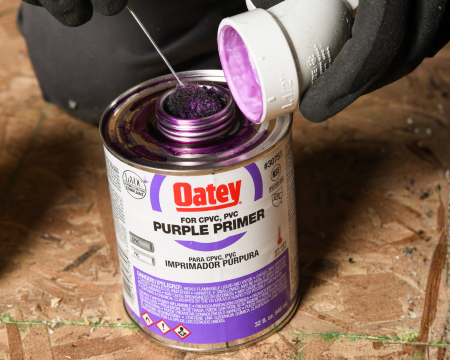
One of the most common solvent welding mistakes is skipping primer when working with PVC or CPVC pipe. Primer is essential because it softens the pipe and fitting surfaces, making them more porous and allowing the cement to create proper fusion and joint strength. In addition, primer is required by plumbing code in most states, making it a compliance issue as well as a performance concern.
When primer is applied correctly, it prepares both surfaces for bonding. The recommended application process involves thoroughly applying primer to the fitting, then the pipe, and then the fitting again, re-dipping the applicator between each step. Once primed, there is a five-minute window to apply solvent cement and complete the joint. Waiting longer than this can interfere with proper bonding and contribute to PVC/CPVC solvent welding issues or joint leaks. You can reapply primer if you elapsed the five-minute window.
ABS pipe is the exception. Primer should never be used on ABS pipe. Single-step products such as Oatey® Fusion® - One Step PVC Cement are also formulated to eliminate the need for a separate primer.
Skipping primer when it is required by material type or local code can prevent the cement from fully penetrating the pipe and fitting surfaces, increasing the risk of weak joints and long-term leaks. For an in-depth explanation of how primer works and when it is required, see What Is Solvent Cement and Primer?
Mistake #2: Using the Wrong Solvent Cement for the Pipe Material
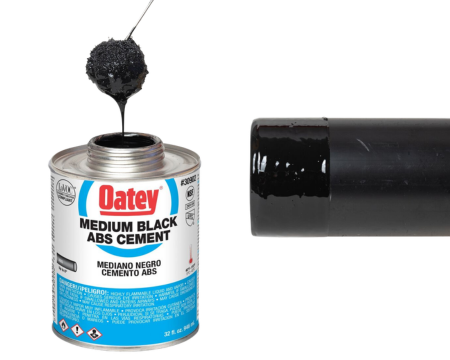
Using the wrong solvent cement is a common cause of joint failure. PVC, CPVC, and ABS are different materials. Each requires a cement specifically formulated to chemically soften and fuse that pipe type.
What differentiates solvent cements:
- PVC solvent cement is designed for use with standard PVC pipe and fittings in both DWV and pressure applications.
- CPVC solvent cement is formulated for CPVC systems that operate at higher temperatures, including hot and cold potable water distribution.
- ABS cement is chemically distinct and is intended only for use with ABS pipe and fittings.
These cements are not interchangeable. Using the wrong product can prevent proper softening of the pipe and fitting surfaces, resulting in weak joints, separation, or PVC joint leaks.
Cement selection must also consider:
- Pipe size: Larger-diameter pipe requires thicker viscosity cement to ensure full surface coverage. Medium body cement may be suitable for 6-inch pipe, while 8-inch pipe typically requires heavy body cement.
- Job conditions: Temperature, moisture, and system type affect performance. Some cements are formulated for cold weather or damp environments, while others are approved for potable water or non-pressure DWV systems.
| Material | Correct Cement | Primer Needed? |
|---|---|---|
| PVC |
Yes *Can be used without a primer where local code permits. |
|
| CPVC | No primer needed where local codes permit | |
| ABS | No |
Always verify the pipe material, pipe size, and job conditions before selecting solvent cement. Using the correct product is critical to avoiding common solvent cement problems and achieving a durable, code-compliant joint.
Mistake #3: Improper Application Technique and Pipe Preparation
Improper preparation and application technique are major contributors to solvent welding failures. Before primer or cement is applied, the pipe must be properly prepared to ensure maximum joint strength.
Proper preparation includes:
- Cut the pipe square – This ensures a maximum surface area for creating fusion and joint strength, resulting in the strongest bond.
- Deburr the pipe – If you don’t, pieces of plastic can break free and move through the system, potentially leading to blockages in items like aerators. Burrs can also catch certain types of debris, which could eventually lead to a blockage in the DWV (drain, waste, vent) system.
- Chamfer the pipe – If you don’t chamfer the pipe or bevel the outside edge, the sharp edges can scrape the cement off the walls of the fitting as the pipe is being inserted. This could potentially cause a blockage or leak paths.
- Clean the pipe – Make sure no dirt or grease can interfere with the cement’s adherence to the pipe. Dirt or grease will reduce the cement’s ability to create proper fusion and joint strength, or scrape the interior of the fitting, creating leak paths.
- Test the interference fit – Before primer or cement is applied to the pipe or fitting, there should be resistance at 1/3 to 2/3 of the fitting hub depth, to ensure a good interference fit. The fittings are slightly tapered and designed to fit together very tightly. If the pipe and the fitting are not a good match, it can lead to a weak joint, pipe separation, or a poor bond.
During assembly, cement must be applied evenly, and the pipe must be pushed fully into the fitting. The joint should be assembled quickly while the surfaces are still softened. A quarter-turn twist helps evenly distribute the cement and improve fusion. After assembly, excess cement should be wiped away, and the joint should be held in place until set.
Failure to follow these steps can lead to common solvent cement problems that appear even when the correct products are used. Visit our Project Guide: How to Easily Connect Pipes Using Solvent Cement for detailed application instructions.
Mistake #4: Ignoring Environmental Conditions
Environmental conditions play a critical role in solvent welding performance. Temperature, humidity, and airflow all affect how solvent cement cures and bonds.
Cold temperatures slow solvent evaporation and can extend cure times. If you know you'll be working in temperatures below 40°F, select a cement that is formulated to fully cure in those temperatures—such as Oatey® All Weather Medium PVC Cement, which is approved for applications at temperatures as low as -15°F.
For additional guidance when working in low-temperature conditions, read Tips for Cold Weather Solvent Welding to help ensure consistent, leak-free joints in colder environments.
High humidity can also delay curing by requiring additional time for the joint to cure fully. In humid environments, allowing fifty percent more cure time is recommended.
Similarly, if you’ll be working in wet or damp conditions, choose a cement that is formulated to cure in damp conditions, like Oatey® Rain-R-Shine® Medium Blue PVC Cement or one of our Oatey® Hot Medium Blue Lava PVC Cement. You should also consider whether you’re working on a potable water system or a non-pressure DWV system, and then select the correct cement for that application.
Without adequate airflow, solvents cannot evaporate properly. Trapped solvent vapors can continue softening the pipe and fitting surfaces, increasing the risk of joint failure over time. This is especially important with enclosed plumbing systems.
Ignoring environmental conditions is a frequent cause of PVC joint leaks that occur after installation, rather than immediately.
Mistake #5: Rushing Set and Cure Time (Testing Too Soon)
Rushing the curing process is one of the most common mistakes in solvent welding, particularly when troubleshooting how to fix a PVC leak after gluing. Solvent cement joints require both set time and cure time, and these are not the same.
Set time is the period required for the joint to gain enough strength to resist minor movement without compromising the bond. During this time, the joint should be left undisturbed.
Cure time is the period required for the joint to harden and reach its designed strength fully. Cure times vary based on pipe material, pipe size, ambient temperature, and humidity. Larger pipe diameters and colder or more humid conditions require longer cure times.
Pressurizing or testing the system too soon can break the developing bond and result in leaks that may not appear until the system is in service.
Bonus Mistake: Reusing Old or Expired Cement
Using old or expired solvent cement is a common issue that can compromise joint performance, even when application steps are followed correctly. Over time, solvent cement can lose its effectiveness due to age or improper storage, preventing the pipe and fitting from properly fusing.
Always inspect cement before use. Solvent cement that has thickened, separated, or developed a jelly-like consistency should not be used. These changes indicate the solvents are no longer properly blended, which can lead to poor softening of the pipe and fitting surfaces and increase the risk of weak joints or leaks.
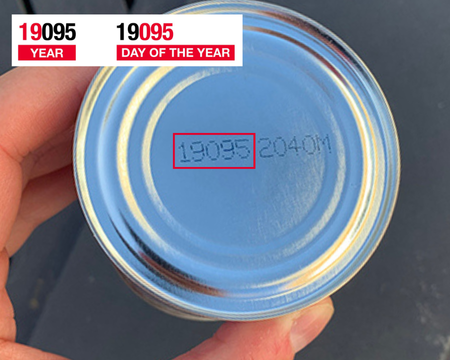
Shelf life is another critical factor. Unopened solvent cement typically has a shelf life of up to three years when stored according to manufacturer recommendations. Once opened, exposure to air and temperature fluctuations can shorten usable life. Containers should be tightly sealed when not in use and stored away from extreme heat or cold to help maintain performance.
Reusing cement that has passed its shelf life or exhibits visible signs of degradation is a preventable cause of solvent welding failure. For more detailed guidance on identifying expired products and proper storage practices, read What Is the Shelf Life of Solvent Cement, Primer, and Cleaner.
Conclusion
Most solvent welding mistakes are preventable with the right products, proper preparation, and patience during the curing process. Choosing the correct cement, using primer when required, preparing pipe correctly, accounting for environmental conditions, and allowing adequate cure time all contribute to strong, leak-free joints.
Oatey experts recommend following proven solvent welding best practices on every job to reduce callbacks and system failures.
For step-by-step solvent welding instructions across PVC, CPVC, and ABS, see our Complete Guide to Solvent Welding PVC, CPVC, and ABS Pipe.
Published on April 24, 2026