
Choosing the right solvent cement is a crucial step in achieving successful solvent welding for various pipe materials. Whether you are new to the trade, a seasoned professional seeking a quick refresher, or a homeowner undertaking your first DIY project, understanding how to choose solvent cement is essential for a strong and reliable pipe connection.
This guide explains how to choose the right solvent cement for PVC, CPVC, and ABS systems so you can approach an installation with confidence. For step-by-step solvent welding instructions, refer to our Complete Guide to Solvent Welding PVC, CPVC, and ABS Pipe.
Why Solvent Cement Selection Matters
Selecting the correct solvent cement is crucial for creating a strong and reliable connection. Using the wrong cement can prevent the pipe and fitting from properly softening and bonding, which may lead to weak joints, leaks, or premature system failure. In some cases, improper cement selection can also result in installations that do not meet local code requirements.
Oatey solvent cements are formulated for specific pipe materials, sizes, and environmental conditions. Each product is designed to support proper solvent welding for various materials, whether the application involves pressure systems, DWV (drain, waste, vent) lines, wet conditions, or extreme temperatures. Matching the cement to the pipe type and jobsite conditions helps ensure long-term performance and code-compliant results.
What Should You Consider Before Selecting a Solvent Cement?
Pipe Material
First, determine whether you will be joining PVC, ABS, or CPVC pipe and fittings. This is one of the most important steps in the process because each material requires a specific cement. If the cement and pipe material do not match, the surfaces cannot properly soften and fuse, which can result in joint failure.
Understanding the differences between PVC and CPVC cement is also important because each material has unique temperature and pressure characteristics.
In the field, solvent cement (sometimes called pipe cement) is often referred to as “glue” or “pipe glue.” However, products used for plumbing are quite different from general-purpose adhesives. Solvent cements are designed to chemically bond—or fuse—plastic pipe and fittings into a single, strong connection.
To learn more about the differences, read Solvent Cement vs. Glue: What Are the Differences?
Understanding Pipe Materials and Solvent Cement Compatibility
This chart supports anyone comparing solvent welding for different materials and helps clarify which cement to use for PVC, CPVC, and ABS applications.
| Pipe Material | Application | Recommended Cement | Notes |
|---|---|---|---|
| PVC | Potable water, pressure pipe, conduit, DWV | Primer required. | |
| CPVC | Hot and cold water systems, specialty waste | Primer required unless code allows one-step. | |
| ABS | Non-pressure residential DWV | Do not use primer on ABS. | |
| Mixed Connections | ABS to PVC transitions | For non-pressure transitions up to 6 inches. |
Pipe Size
Cement viscosity affects its performance with different pipe diameters. Larger pipes require heavier-bodied cements. Use the chart below as a general reference for cement body type selection; always confirm the maximum pipe size listed on the cement can.
Pipe Size Chart
| Cement Body | All Schedules* | Pressure | Non-Pressure |
|---|---|---|---|
| Regular | N/A | Up to 2 inches | Up to 4 inches |
| Medium | Up to 6 inches | N/A | N/A |
| Heavy | N/A | Up to 12 inches | Up to 18 inches |
| Extra Heavy | N/A | Up to 24 inches | Up to 30 inches |
*Schedule refers to pipe wall thickness.
Application Conditions
Jobsite conditions play an important role in selecting the right solvent cement. Factors like temperature, moisture, pipe size, and system type all influence how a solvent weld forms and performs. Choosing a cement rated for the conditions helps support a strong, reliable connection.
- Temperature: Most solvent cements are designed for application between 40°F and 110°F. Colder temperatures slow the bonding process, while warmer conditions allow the joint to set more quickly. If you are working in cold weather or extreme conditions, choose a cement formulated for those environments.
- Moisture and wet conditions: Some repairs must be completed when water cannot be fully shut off. In these situations, use a cement designed to perform in wet conditions. These cement formulas allow solvent welding to occur even when moisture is present in the pipe.
- Pipe size and pressure: Larger-diameter pipe requires thicker, heavier-bodied cement to ensure proper coverage and penetration. Pressure-rated systems also require cements approved for that use. Always confirm the cement matches both the pipe size and system type.
- Cure time considerations: Cure time varies with temperature, pipe size, and cement formulation.
Oatey Tip: Always follow the instructions on the cement label before pressurizing the system.
For step-by-step solvent welding guidance and cure-time considerations by application, see our Complete Guide to Solvent Welding PVC, CPVC, and ABS Pipe.
Local Codes and Standards
Local plumbing codes play a crucial role in selecting the most suitable solvent cement for any installation. Many jurisdictions require the use of purple primer on PVC and CPVC joints so inspectors can verify proper surface preparation. Some locales permit one-step CPVC products; others require a separate primer. These circumstances make it essential to understand the differences between PVC and CPVC cement, as well as local requirements, when selecting solvent cement.
Codes may also limit how materials connect, such as allowing only one ABS-to-PVC transition joint per application. Temperature and pressure ratings listed on cement labels must match the system's demands to ensure safe, code-compliant solvent welding for various materials.
Always review local regulations or consult an inspector to confirm that the selected cement and primer meet regional standards.
What Can You Use to Join PVC?
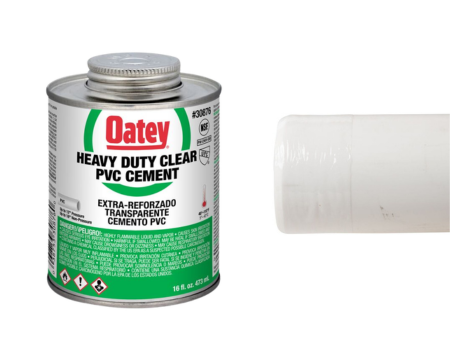
PVC solvent cements are used for potable water, pressure pipe, conduit, and DWV applications. While many PVC cements are approved for similar uses, differences in body type and formulation affect working time, coverage, and performance in challenging conditions such as cold weather or wet environments. The options below compare common PVC solvent cements to help you choose the right one for your application.
| Product | Typical Uses | Key Differentiator | Primer Requirement |
|---|---|---|---|
| Oatey® Medium Clear PVC Cement | General-purpose PVC installs: DWV, pressure pipe, potable water, conduit | Balanced formula for common PVC work | Primer typically required for PVCPrimer typically required for PVC — Follow code/label instructions |
| Oatey® Heavy Duty Clear PVC Cement | Larger-diameter PVC / looser-fit joints | Thicker formula for improved coverage and gap-filling | Primer typically required for PVC — Follow code/label instructions |
| Oatey® Hot Blue Lava® PVC Cement | Repairs and installs in challenging conditions (wet/damp), irrigation, pool & spa, DWV repair | Fast-setting; performs well in wet conditions | Primer recommended for pressure systems —Follow code/label instructions |
Selection tips:
- Use medium-bodied cements for small- to mid-diameter PVC pipe under normal conditions.
- Choose heavy-duty formulations for larger pipe sizes that require greater coverage.
- For cold, wet, or time-sensitive repairs, a fast-setting cement may be the better option.
What Can You Use to Join ABS?
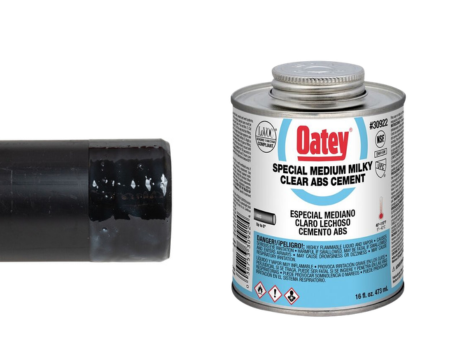
ABS solvent cements are used for non-pressure residential DWV applications. Unlike PVC and CPVC, ABS solvent welding does not require primer; in fact, primer should not be used on ABS, as it can be detrimental to proper solvent weld performance. The primary differences between ABS cements relate to body type, set speed, and visibility after application. The options below compare common ABS solvent cements to help you choose the right one for your installation.
| Product | Typical Uses | Key Differentiator | Primer Requirement |
|---|---|---|---|
| Oatey® ABS Medium-Bodied Black Cement | Non-pressure ABS DWV systems (up to 6" interference fit) | Standard ABS cement for DWV | Do not use primer for ABS |
| Oatey® Special Medium Milky Clear ABS Cement | Finished or visible ABS installations | Fast-setting formula with milky-clear finish for reduced visual residue | Do not use primer for ABS |
Selection tips:
- Use medium-bodied ABS cement for most residential DWV installations.
- Choose a milky-clear formulation when appearance matters or when minimizing visible residue is preferred.
Reminder: Primer should not be used on ABS solvent welds.
What Can You Use to Join CPVC?
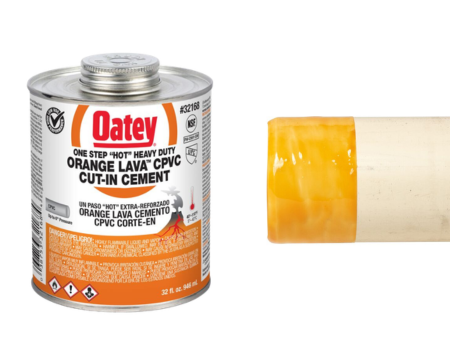
CPVC solvent cements are formulated for hot- and cold-water plumbing systems and require CPVC-specific chemistry to handle higher operating temperatures. CPVC cement selection depends on pipe size, repair vs. installation needs, and whether one-step or two-step cementing is permitted by local code. The options below compare common CPVC solvent cements to help you select the right one for your application.
| Product | Typical Uses | Key Differentiator | Primer Requirement |
|---|---|---|---|
| Oatey® Orange Lava CPVC Cut-In Cement | Time-sensitive cut-in/repair work; commercial cold/hot water systems | Designed for quick repairs / limited downtime | Primer not required per one-step usage where local codes permit |
| Oatey® FlowGuard Gold® 1-Step Yellow Cement | Cold and hot water systems (up to 200°F) | All-weather one-step cement | No primer needed where local codes permit |
| Oatey® Medium Orange CPVC Cement | Standard CPVC installs when more working time is needed (up to 200°F systems) | More working time vs faster-set options | Primer required |
Selection tips:
- Use one-step CPVC cements for repairs or installations where local code allows primer-free application.
- Choose medium-bodied CPVC cement for standard installations requiring longer working time.
- Always verify pipe system compatibility and code requirements before selecting a CPVC cement.
What Can You Use to Join ABS and PVC?
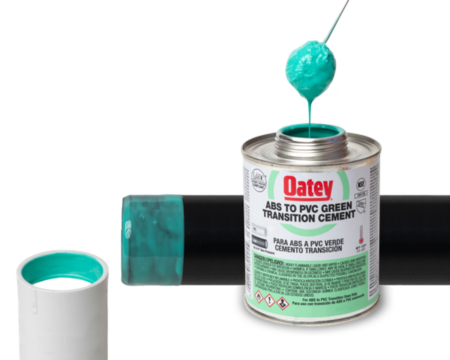
When transitioning between ABS and PVC, use a cement specifically formulated for mixed materials. These products support proper solvent welding for different materials in non-pressure applications. Recommended when a mechanical transition is not feasible.
| Product | Typical Uses | Key Differentiator | Primer Requirement |
|---|---|---|---|
| Oatey® ABS To PVC Transition Green Cement | Non-pressure ABS↔PVC transition joints (up to 6") | Formulated specifically for ABS-to-PVC transitions | Do not use primer |
Oatey Tip: Many jurisdictions allow one ABS-to-PVC transition per application.
Solvent Cement Selection Process
The steps below outline how to narrow down the correct solvent cement before installation.
- Identify the pipe material: PVC, CPVC, ABS, or a transition between materials.
- Evaluate the jobsite conditions: Temperature, moisture, pressure, and system type.
- Determine the required cement body: Regular, Medium, Heavy, or Extra Heavy.
- Confirm primer requirements: PVC and CPVC typically require primer, unless a one-step formula approved by local code is used.
- Review cure time guidance: Follow label instructions and consider jobsite timing needs when selecting a cement.
This process helps you narrow down the best solvent cement for each application.
Ready to start your project? Follow our Complete Guide to Solvent Welding PVC, CPVC, and ABS Pipe for step-by-step best practices. If you prefer a faster checklist-style walkthrough, use our Solvent Welding Project Guide.
Solvent Cement Line Overview
Below is a quick reference list of Oatey’s most trusted solvent cements. Use this chart to compare pipe material compatibility, cement body type, and application temperature range (the outdoor/ambient temperature the product is designed to be applied in).
Note that system operating temperature is different from application temperature and is included in the use-case notes where relevant.
Oatey Tip: Always follow the instructions on the cement label and confirm compatibility with your pipe material and application.
| Product | Pipe Material | Body Type | Use Case | Application Temperature Range |
|---|---|---|---|---|
| Oatey® Medium Clear PVC Cement | PVC | Medium | General-purpose installs; balanced, reliable choice for common PVC work | 40°F to 110°F |
| Oatey® Heavy Duty Clear PVC Cement | PVC | Heavy | Large diameter / loose-fit coverage; thicker formula for gap filling | 40°F to 110°F |
| Oatey® Hot Medium Blue Lava PVC Cement | PVC | Medium | Wet/damp conditions; fast-setting for quicker turnaround | 40°F to 110°F |
| Oatey® Orange Lava CPVC Cut-In Cement | CPVC | Medium | Cut-in/repair work with limited downtime; fast-curing one-step | 40°F to 110°F |
| Oatey® FlowGuard Gold® 1-Step Yellow Cement | CPVC | Medium | All-weather one-step for CTS systems; no primer where permitted | 0°F to 110°F |
| Oatey® Medium Orange CPVC Cement | CPVC | Medium | When more working time is needed; general CPVC installations | 40°F to 110°F |
| Oatey® ABS Medium-Bodied Black Cement | ABS | Medium | Standard non-pressure ABS work; up to 6 in. with interference fit | 40°F to 110°F |
| Oatey® ABS To PVC Transition Green Cement | ABS ↔ PVC | Medium | Non-pressure ABS↔PVC transitions; DWV/sewer connections | 40°F to 110°F |
| Oatey® Fusion® - One Step PVC Cement | PVC | Medium | One-step option for residential/DIY; self-priming | 40°F to 110°F |
Common Mistakes When Selecting Cement
These mistakes are common among installers learning how to select solvent cement or compare different types of solvent cement for a project. Avoiding them supports long-lasting, reliable solvent welding for different materials.
- Choosing a cement that does not match the pipe material
- Skipping primer on PVC or CPVC
- Ignoring temperature, moisture, or pressure conditions
- Using expired cement or cement that has thickened and developed a jelly-like consistency
For more mistakes to avoid, read our blog 5 Common Solvent Welding Mistakes.
Conclusion
Once you’ve selected the right solvent cement based on pipe material and application conditions, you’re on your way to successful results.
Want step-by-step instructions? See our Complete Guide to Solvent Welding PVC, CPVC, and ABS Pipe, or if you want a faster checklist-style walkthrough, use our Solvent Welding Project Guide.
Published on April 10, 2026