
Many people casually refer to solvent cement as glue, especially when browsing the plumbing aisle or discussing do-it-yourself projects. Even seasoned pros admit the terminology can be hard to shake. But in plumbing, glue and solvent cement are not the same thing—and mixing them up can lead to leaks, failed inspections, or system breakdowns.
Understanding the difference is the first step to making strong, code-compliant plastic pipe connections. As a leader in solvent welding education, Oatey is committed to helping homeowners and apprentices get it right from the very beginning.
In this blog, we’ll explain the differences between glue and solvent cement at a high level. For step-by-step instructions on making solvent-welded joints, see our Complete Guide to Solvent Welding PVC, CPVC, and ABS Pipe.
Quick Answer: Solvent cement and glue are not the same. Glue creates a surface bond, while solvent cement chemically softens and fuses compatible PVC, CPVC, and ABS pipe and fittings into a permanent solvent-welded joint. If you’re searching for the best adhesive for PVC pipe in a plumbing project, the correct product is PVC, CPVC or ABS solvent cement — not general-purpose glue or household adhesive.
What Is Glue?
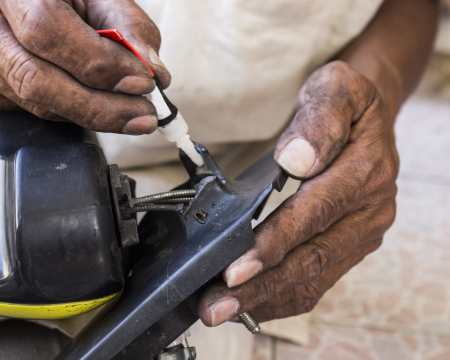
Glue, such as Elmer’s or Super Glue, is an adhesive designed to adhere to the surface of materials and create a mechanical bond. Whether it’s wood glue, construction adhesive, or epoxy, the material works by drying or hardening—not by chemically altering the surfaces it touches.
Importantly, glue does not dissolve PVC, CPVC, or ABS pipe, and it does not fuse these plastics together. For that reason, glue cannot create a permanent, watertight plumbing connection.
Quick takeaway: Glue bonds to a surface; it does not chemically fuse plastic pipe.
What Is Solvent Cement?
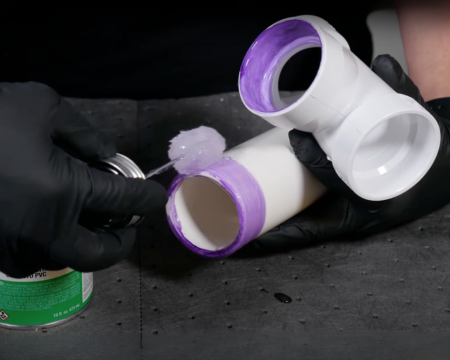
Solvent cement, also known as PVC cement or “pipe glue,” is not an adhesive. It’s a chemical welding agent formulated specifically for PVC, CPVC, and ABS pipe and fittings. When applied, solvent cement:
- Softens and penetrates the surface of the pipe and fitting (a chemical reaction).
- Allows the two surfaces to fuse together as the solvent evaporates.
- Creates a permanent, monolithic bond that becomes as strong as, or stronger than, the pipe itself.
This process is known as solvent welding. True solvent welds rely on both the chemistry of the cement and the mechanical design of the system—specifically, the interference fit inside a tapered fitting. The taper ensures the pipe tightens as it seats, allowing the chemical fusion to occur where the pressure is greatest. Outside of that area, you may get some bonding, but not a full solvent weld.
Quick takeaway: Solvent cement does not simply stick pipe together; it creates a chemical weld between compatible plastic surfaces.
To understand the basics of solvent cement and primer, read What Is Solvent Cement and Primer?
Key Differences Between Glue and Solvent Cement
| Feature | Glue | Solvent Cement |
|---|---|---|
| Bond Type | Mechanical (surface adhesion) | Chemical fusion (molecularly fuses plastics) |
| How It Hardens | Dries | Solvent evaporates after softening the pipe surfaces |
| Compatible Materials | Wood, metal, general materials | PVC, CPVC, ABS pipe and fittings |
| Strength | Moderate | Permanent, watertight |
| Plumbing Use | Not approved | Industry standard |
| Process Required | Spread and stick | Surface prep / primer where required → cement → assemble → cure |
Note: Primer requirements vary by material, product type, and local code. Always follow label instructions and local requirements.
In plumbing, always solvent weld—never use glue.
Why the Confusion Exists
The term “PVC glue” has been in use for decades, and many consumers continue to use it today. Some very old products, including historic cans from Oatey’s own archives, used the term “glue” on their labels. But Oatey currently labels all solvent cement products as such. Because “PVC glue” is often used casually, check the label carefully. For plumbing pipe, the product should be a solvent cement labeled for the pipe material and application.
This long-standing habit explains why homeowners often reach for “glue” when they really need solvent cement.
To the naked eye, both glue and solvent cement may appear similar once a joint has dried—they hold two parts together. But their behavior is different.
- Glue applied to PVC will simply harden on the surface.
- Solvent cement will soften the pipe itself because it’s chemically altering the plastic.
- Once cured, the joint cannot be moved or separated—it has fused.
This chemical action is what makes a solvent-welded joint strong enough for plumbing.
When to Use Solvent Cement vs. Glue
Use Solvent Cement When Working With:
- PVC, CPVC, or ABS pipe
- Plumbing systems requiring permanent, watertight seals
- Applications governed by code and inspection requirements
Use Glue Only For:
- Crafts
- Temporary repairs that are not part of pressurized or DWV plumbing systems
- Bonding flat sheets of PVC material (for which Oatey does not make a cement)
— In these cases, a construction adhesive or specialty glue may be appropriate.
Glue should never be used on pressurized or DWV plumbing systems.
Now that you understand why solvent cement is required for plumbing, the next step is choosing the right formula for your specific application.
Quick Oatey Solvent Cement Breakdown
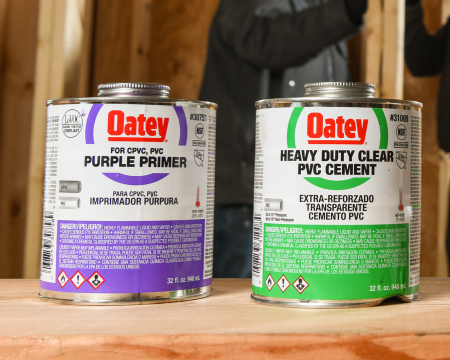
The products below are examples of solvent cement options for common applications. Always confirm compatibility, label instructions, and local code requirements before use.
| Application | Solvent Cement | Recommended Uses | Primer Requirement |
|---|---|---|---|
| PVC – Standard Use | Oatey® Regular Clear PVC Cement | DWV, pressure pipe, potable water, electrical applications | Requires primer |
| PVC – Wet or Cold Conditions | Oatey® Rain-R-Shine® Blue PVC Cement | Pool and spa, irrigation, potable water, pressure pipe, DWV; aggressive formula for damp/humid environments | One-step (no primer required) where local code permits. |
| PVC – Quick DIY Fixes or Creative Pipe DIYs | Oatey® Fusion® - One Step PVC Cement | DIY projects, quick fixes, general-purpose PVC bonding | One-Step (no primer needed) |
| CPVC | Oatey® CPVC FlowGuard Gold® Cement | Cold water systems; hot water up to 200°F / 93°C | One-step (no primer needed) |
| ABS | Oatey® ABS Medium-Bodied Black Cement | Non-pressure applications | Never use primer |
Oatey tip: Primer is commonly used on PVC joints and may be required by code. Always follow label instructions and local requirements, and never use primer on ABS.
To learn how to select a solvent cement for your pipe project, read: How to Choose the Right Solvent Cement for the Job.
How Solvent Welding Works (Quick Recap)
- Surface prep / prime where required: Prepares and softens the plastic.
- Apply cement: Begins the chemical reaction.
- Assemble quickly: Insert the pipe into the tapered fitting to allow the weld to take place.
- Allow to cure: The two parts fuse into a single, durable piece.
Some solvent cements are “one-step,” but primer requirements vary by material, product, and local code. Always follow label instructions and local requirements.
For a step-by-step guide on solvent welding, read: How to Easily Connect Pipes Using Solvent Cement.
Conclusion
Solvent cement and glue may look similar at first glance, but they work very differently. For plumbing systems, solvent cement is the correct choice because it chemically welds compatible plastic pipe and fittings into a permanent connection. If you’re ready to apply what you’ve learned, follow our Complete Guide to Solvent Welding PVC, CPVC, and ABS Pipe or use our Solvent Welding Project Guide for step-by-step instructions.
Published on July 03, 2026
Frequently Asked Questions
-
Is PVC glue the same as solvent cement?
-
No. In plumbing, people often use “PVC glue” to mean PVC solvent cement, but true glue only adheres to surfaces. Solvent cement chemically fuses compatible plastic pipe and fittings.
-
-
What is the best adhesive for PVC pipe in a plumbing project?
-
For plumbing pipe, the correct product is not a general-purpose adhesive. Use a PVC solvent cement that is labeled for the pipe material, system type, and application.
-
-
Can I use glue instead of solvent cement for plumbing?
-
No. Glue cannot create a permanent, watertight, code-compliant plumbing connection. Use solvent cement for PVC, CPVC, or ABS pipe and fittings.
-
-
Why do some products label themselves as “PVC glue”?
-
“PVC glue” is a common nickname that has been used for years, but solvent cement works differently from glue. It softens and fuses the plastic instead of simply sticking to the surface.
-
-
Does solvent cement work like regular glue?
-
No. Regular glue dries on the surface of materials. Solvent cement softens compatible plastic pipe and fittings so they can chemically weld together.
-
-
Do I need a primer when using solvent cement?
-
Primer requirements depend on the pipe material, cement type, product label, and local code. PVC and CPVC commonly require primer unless a one-step product is permitted. Do not use primer on ABS.
-
-
How do I choose the right solvent cement for PVC, CPVC, or ABS pipe?
-
Match the cement to the pipe material and application. PVC, CPVC, and ABS each require compatible solvent cement formulations. For more guidance, see How to Choose the Right Solvent Cement for the Job.
-