


PVC pipe is a lightweight, affordable, and versatile material for household repairs, organization projects, garden structures, crafts, and other creative builds. Properly solvent welding the pipe and fittings helps create a secure, reliable connection.
This project guide explains how to use Oatey® Fusion® One-Step PVC Cement for compatible PVC repairs, plumbing projects, and crafts. Fusion is a clear, medium-bodied, single-step, self-priming PVC cement.
For broader solvent welding guidance across PVC, CPVC, and ABS pipe, see How to Solvent Weld PVC, CPVC, and ABS Pipe.
See how Fusion simplifies PVC solvent welding with a single-step, self-priming formula.
Why Use Fusion for PVC DIY Projects?
Fusion’s clear, medium-bodied, low-VOC formula clings to the pipe surface to help reduce drips, does not stain, and leaves a transparent finish. It is designed for residential and DIY plumbing, quick fixes, and PVC craft projects.
How to Solvent Weld PVC Pipe for DIY Projects
Even if you have never worked with PVC before, solvent welding is a straightforward process. Follow the steps below and the instructions on the Fusion product label.
What You'll Need For This Project
- Oatey® Fusion® One-Step PVC Cement
- PVC pipe
- PVC fittings
- Tape measure
- PVC cutter or fine-tooth saw
- Chamfering tool, file, or deburring tool
- Rag or paper towel
- Protective covering for nearby floors or work surfaces
- Appropriate personal protective equipment, including gloves and eye protection
Step 1. Measure and Cut the PVC
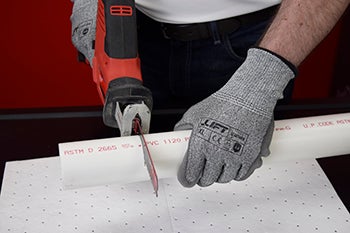
Measure the PVC pipe and mark the desired length. Use a PVC cutter or fine-tooth saw to make a square cut.
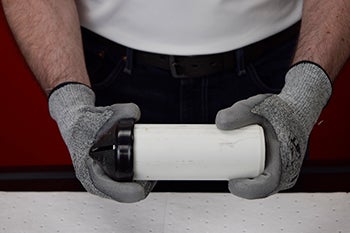
Deburr the inside edge and chamfer the outside edge with a file, chamfering tool, or deburring tool so the pipe fits smoothly into the fitting. Remove loose plastic, dirt, and debris before dry fitting.
Step 2. Dry-Fit the Pieces
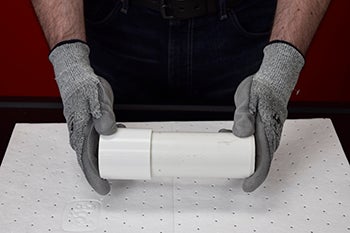
Insert the pipe into the fitting without cement to confirm the fit, measurements, and alignment.
Mark the insertion depth and fitting orientation. These marks will help you position the pieces quickly once the cement is applied.
Step 3. Clean the Pipe and Fitting
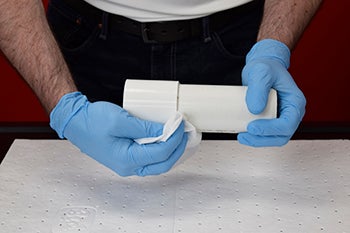
Make sure the pipe and fitting surfaces are clean and free of dirt, grease, paint, and debris.
Fusion is self-priming and may be used without a separate primer where local code permits. Clean surfaces are still necessary for proper solvent welding. Always follow the Fusion product label and local code requirements.
To learn how primer works with traditional two-step solvent cements, see What Is Solvent Cement and Primer?
Step 4. Apply Fusion
Use a suitable applicator that is at least half the size of the pipe diameter. For larger pipe systems, use an appropriate natural-bristle brush or roller.
Apply a liberal coat of Fusion to the outside of the pipe to the full depth of the fitting socket, leaving no uncoated surface.
Apply a thin coat to the inside of the fitting. Avoid puddling the cement, which can weaken the pipe or fitting. Re-dip the applicator, then apply a second coat to the outside of the pipe.
For additional troubleshooting guidance, see 5 Common Solvent Welding Mistakes to Avoid.
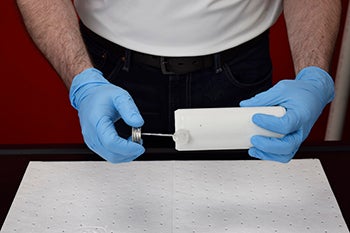
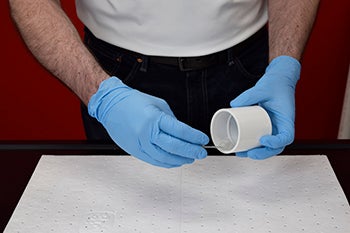
Step 5. Insert, Rotate, and Hold the Pipe
Push the pipe fully into the fitting and rotate it one-quarter turn to distribute the cement.
Hold the joint together for approximately 30 seconds to help prevent push-back. Pipe and fittings may vary slightly within their manufacturing tolerances, so maintaining pressure helps keep the pipe fully seated while the joint begins setting.
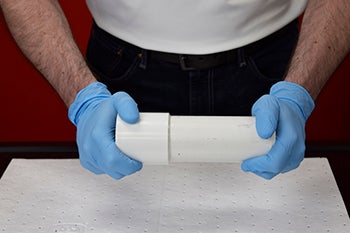
Step 6. Wipe Away Excess Cement
Use a rag or paper towel to remove excess cement that may have been pushed out of the joint during assembly, if needed. Fusion’s clear formula clings to the pipe surface to help reduce drips and minimize visible residue.
Step 7. Allow the Joint to Set and Cure
For the small, non-pressure DIY projects featured in this guide, set time is usually 2–5 minutes. Do not move or pull apart the joint during this period. Set time is not the same as full cure time or pressure-test readiness.
For most small PVC projects using ½- to 2-inch pipe, about 30 minutes of cure time is typically sufficient before handling or painting. This helps paint adhere properly and gives the joint additional time to develop strength.
These timing guidelines apply to the small, non-pressure DIY projects featured on this page; they are not pressure-testing or return-to-service times.
Cure and handling times can vary based on temperature, pipe size, and project conditions, so always follow the product label instructions.
Document Downloads (1)
Popular PVC DIY Projects Using Fusion
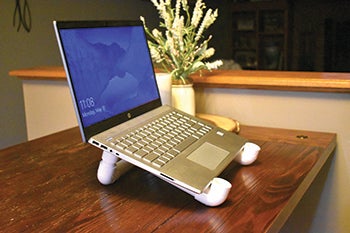
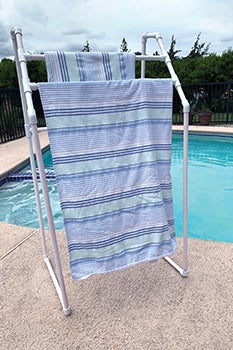
PVC pipe can be used for many practical and creative household projects, including:
- Storage racks and household organizers
- Laptop stands
- Lightweight shelving
- Small tables or furniture frames
- Garden trellises and plant frames
- Towel racks
- Decorative craft structures
- Tee-ball stands and other backyard projects
Fusion’s one-step formula simplifies assembly for compatible PVC DIY and craft projects.
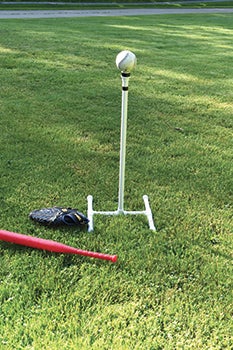
When Fusion Is Not the Right Choice
Fusion is designed for compatible PVC pipe and fittings, but it is not appropriate for every material or application.
- CPVC or ABS pipe: Fusion is formulated specifically for PVC.
- Flat PVC trim materials: Trim boards, window trim, and baseboards do not form the interference-fit joint required for solvent welding.
- Applications outside the product’s listed size and use limits: For pressure applications, Fusion is approved for PVC pipe and fittings up to 4 inches. For non-pressure applications, it is approved up to 6 inches with interference fit.
- Application temperatures outside 40°F to 110°F: Follow product-specific technical guidance before use.
- Dirty, painted, or heavily contaminated surfaces: Solvent cement must contact properly prepared PVC surfaces.
- Projects requiring a different formulation: Some system types or jobsite conditions may require another PVC solvent cement.
Need a Different Solvent Cement?
For pressure applications, Fusion can be used on all schedules and classes of PVC pipe and fittings up to 4 inches. For non-pressure applications, it can be used up to 6 inches with interference fit.
For applications outside those limits, or projects requiring a different formulation based on system type, pressure, pipe size, or jobsite conditions, see How to Choose the Right Solvent Cement for the Job.
Common Fusion Application Mistakes
Avoid these common problems when assembling PVC DIY projects:
- Dirty or painted surfaces: Contaminants can prevent the cement from properly contacting the PVC.
- Incomplete cement coverage: Apply a liberal coat to the pipe to the full depth of the fitting socket and a thin coat inside the fitting; avoid puddling.
- Waiting too long before assembly: Assemble the joint immediately while the cement remains fluid.
- Not holding the joint: Hold the pipe and fitting together long enough to help prevent push-back.
- Handling the project too soon: Allow the joint to set and cure according to the product label.
- Using Fusion on the wrong pipe material: Fusion is formulated for PVC, not CPVC or ABS.
Having trouble with a solvent welded joint? See 5 Common Solvent Welding Mistakes to Avoid.
Bottom Line
Fusion simplifies compatible PVC DIY projects by combining priming and cementing into one application. Proper surface preparation, even cement coverage, quick assembly, and adequate set and cure time are still essential for a reliable connection.
Review the Fusion product page for current specifications, application instructions, and cure guidance.
For the complete solvent welding process across PVC, CPVC, and ABS, see How to Solvent Weld PVC, CPVC, and ABS Pipe.
Published on August 28, 2026
Frequently Asked Questions
-
What is Oatey Fusion One-Step PVC Cement?
-
Fusion is a clear, self-priming PVC solvent cement designed for compatible residential, DIY plumbing, quick-fix, and PVC craft projects.
-
-
Does Fusion require a separate primer?
-
Fusion is self-priming and may be used without a separate primer where local code permits. Always follow the product label and local code requirements.
-
-
What pipe sizes can Fusion be used on?
-
For pressure applications, Fusion can be used on all schedules and classes of PVC pipe and fittings up to 4 inches. For non-pressure applications, it can be used up to 6 inches with interference fit. Always follow the product label and local code requirements.
-
-
Can I use Fusion for PVC crafts and simple repairs?
-
Yes. Fusion can be used for compatible PVC DIY, craft, quick-fix, and residential applications. Confirm that the pipe, fitting, size, and application meet the product-label requirements.
-
-
Can I use Fusion for pressurized plumbing?
-
Yes. Fusion can be used on all schedules and classes of PVC pipe and fittings up to 4 inches for pressure applications. Always follow the product label and local code requirements.
-
-
How long should a Fusion joint set or cure before handling or pressure testing?
-
At temperatures above 60°F, allow at least 15 minutes for good handling strength. Before pressure testing, follow the Fusion cure chart for the exact pipe diameter, temperature, pressure, and application. Longer cure times may be required below 60°F or with pipe larger than 3 inches.
-
-
What temperature range can Fusion be applied in?
-
Fusion is recommended for application between 40°F and 110°F (4°C and 43°C). Follow the product label for storage, application, and cure requirements.
-
-
Can I use Fusion on CPVC, ABS, painted, or dirty pipe?
-
No. Fusion is formulated for PVC and should not be used on CPVC or ABS. PVC surfaces must also be clean and properly prepared before application.
-