
Air Admittance Valves (AAVs) are one-way mechanical plumbing vents that allow air into drainage systems without requiring a roof penetration. Oatey Sure-Vents, sometimes referred to as Studor vents or mini vents, provide a cost-effective alternative to traditional plumbing vent systems by opening to admit air when negative pressure develops and closing to prevent sewer gas from escaping into buildings.
Understanding how AAVs work and when to use them can save homeowners and contractors significant time and money on plumbing installations, remodels, and additions.
How Do Drain-Waste-Vent (DWV) Systems Work?
Plumbing Drain-Waste-Vent systems (DWV) consist of two essential components: drain pipes that remove waste and vent pipes that prevent sewer gas from entering buildings while maintaining proper pressure balance. The DWV system relies on gravity and air displacement to function correctly.
Think of a to-go coffee cup lid with tiny holes that allow air into the container. Without proper airflow, there wouldn't be enough pressure for liquid to flow out evenly. The same principle applies to plumbing: for water to drain out, air must come in.
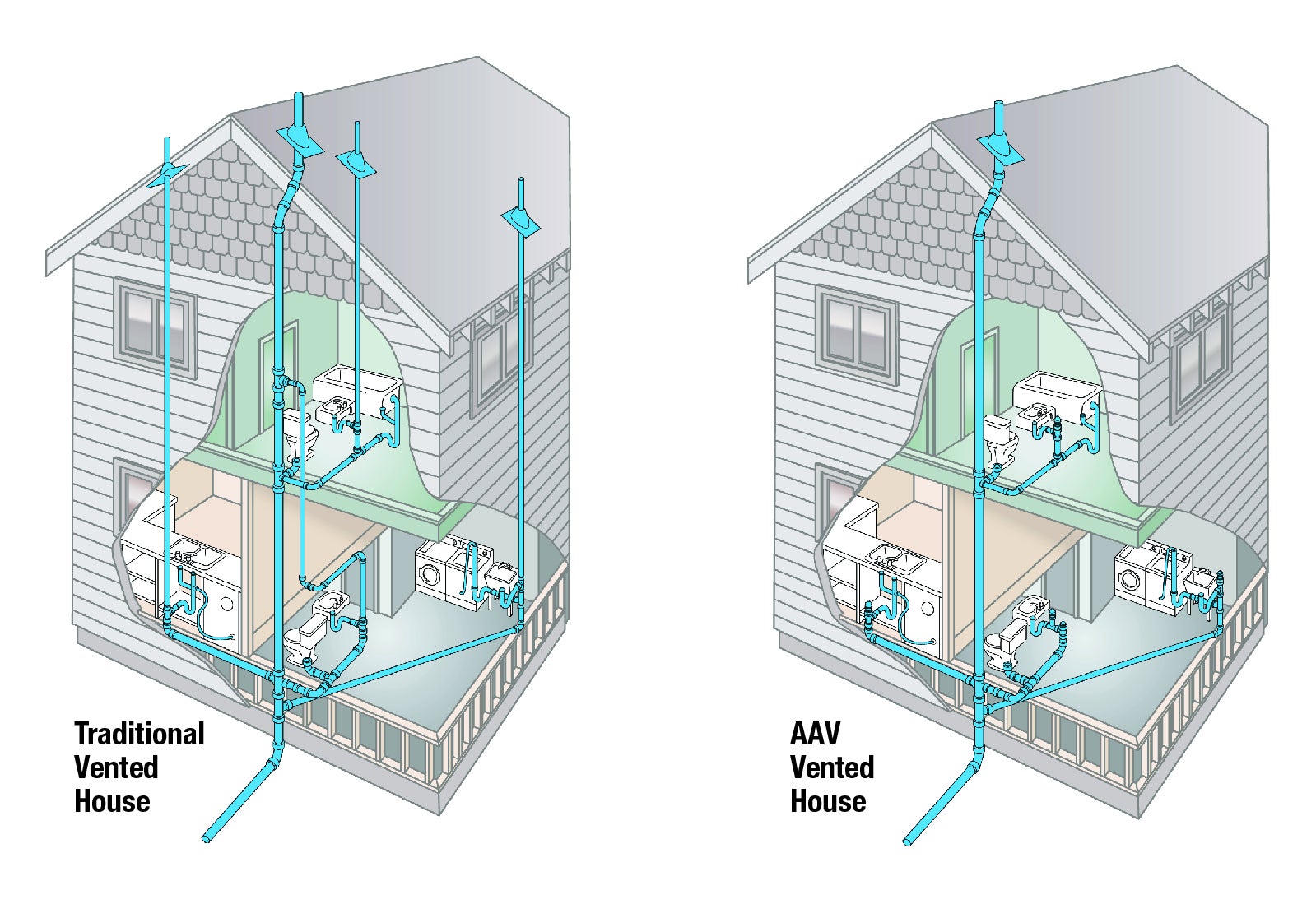
All DWV plumbing systems require at least one vent penetration through the roof line, which allows air to enter the system while permitting sewer gas to escape. However, connecting all plumbing fixtures to existing venting systems can be complex, expensive, and limiting—which is where Air Admittance Valves provide a practical solution.
How Does an Air Admittance Valve Work?
AAVs operate automatically based on pressure changes in the drainage system. When water flows through drain pipes, it creates negative pressure in the piping system. The AAV responds by opening to allow air into the system, which prevents drain traps from being siphoned dry.
When pressure equalizes (indicating no water is flowing), gravity automatically closes the vent terminal, preventing sewer gases from escaping into the building. This mechanical operation requires no electricity or manual intervention.
Important: All buildings must still have at least one traditional stack vent penetrating the roof. An AAV supplements but does not replace this primary venting requirement for the building as a whole.
When Do You Need an Air Admittance Valve?
AAVs are most commonly needed when you can't connect to an existing vent system, want to reduce roof penetrations, or need to lower installation costs.
1. When You Can't Connect to an Existing Plumbing Vent System
AAVs provide an ideal venting solution when connecting to existing vent systems is impractical due to:
- Complex pipe routing issues
- Physical obstructions in walls or ceilings
- Distance from existing vent stacks
- Structural limitations in the building
Common applications include island sinks, remote bathroom groups, home remodels, and additions that would otherwise require specialized venting techniques. AAVs allow homeowners and contractors more flexibility in plumbing fixture layout without compromising plumbing code compliance.
2. To Reduce Roof Penetrations and Improve Aesthetics
AAVs open and close automatically with normal DWV system operation, eliminating the need for additional roof penetrations. Many homeowners prefer not to add vent pipes through the roof line for design and aesthetic reasons.
Reducing roof penetrations also decreases the risk of roof leaks over time, as each penetration represents a potential failure point in the roofing system.
3. To Save Money on Plumbing Installation Costs
Using AAVs requires significantly less labor and materials compared to running traditional vent pipe through walls, attics, and roofs. In new construction applications, AAVs can reduce plumbing installation costs by 30-50% for fixtures located far from existing vent stacks.
The cost savings come from:
- Reduced pipe materials and fittings
- Less labor time for installation
- Fewer roof penetrations and flashing requirements
- Simplified rough-in work
Are Air Admittance Valves Allowed by Plumbing Code?
AAV acceptance varies by jurisdiction and local plumbing code. Most areas in the United States now permit AAVs under the International Plumbing Code (IPC) and Uniform Plumbing Code (UPC), but specific installation requirements and limitations apply.
Always check with your local building department or municipality before installing an AAV to confirm the installation will be approved for your particular application. Some jurisdictions may restrict AAV use to specific applications or require additional documentation.
What Are the Installation Requirements for Air Admittance Valves?
Proper AAV installation requires following these key guidelines:
- Location: AAVs must be installed above the flood level rim of the fixture they serve
- Access: AAVs require accessible locations for inspection and maintenance
- Ventilation: The space containing the AAV must have adequate air circulation
- Orientation: AAVs must be installed vertically with the valve opening upward
- Support: Proper pipe support prevents stress on the valve mechanism
Consult manufacturer specifications and local plumbing codes for complete installation requirements specific to your application.
What Are the Advantages of Using Air Admittance Valves?
The primary benefits of AAVs include:
- Cost savings: Reduce installation costs by 30-50% compared to traditional venting
- Design flexibility: Allow fixture placement in locations difficult to vent conventionally
- Faster installation: Simplify rough-in work and reduce labor time
- Fewer roof penetrations: Minimize potential leak points and improve aesthetics
- Easier remodeling: Enable bathroom and kitchen additions without major structural modifications
- Code-compliant:Approved under most modern plumbing codes when properly installed
Published on June 04, 2026
Frequently Asked Questions
-
What is the difference between an AAV and a traditional plumbing vent?
-
Traditional plumbing vents are passive pipes that extend through the roof to allow continuous air exchange, while AAVs are mechanical valves that open only when needed to admit air and close to prevent gas escape. Traditional vents provide two-way airflow; AAVs provide one-way airflow only.
-
-
Can an AAV completely replace roof vents in a building?
-
No, all buildings must have at least one traditional stack vent penetrating the roof. AAVs can supplement this primary vent but cannot completely replace the building's main venting system.
-
-
How long do Air Admittance Valves last?
-
Quality AAVs typically last many years when properly installed and maintained. However, actual lifespand depends on installation conditions and usage. Depending on these factors, the mechanical seal and spring mechanism may eventually wear out and require replacement.
-
-
Do AAVs require maintenance?
-
AAVs require minimal maintenance but should be inspected periodically to ensure proper operation. The valve should be accessible for inspection and replacement if needed.
-
-
Where should you not install an Air Admittance Valve?
-
Do not install AAVs in locations without adequate ventilation, below the flood level rim of fixtures, in inaccessible locations, or in jurisdictions where local plumbing code prohibits their use.
-
-
Can I use an AAV for a toilet?
-
Yes, AAVs can be used to vent toilets in most jurisdictions, provided the installation meets local plumbing code requirements and the AAV is properly sized for the fixture unit load.
-
-
What size AAV do I need for my plumbing fixture?
-
AAV sizing depends on the fixture unit load being served. Common residential AAVs handle 20-160 drainage fixture units (DFU). Consult manufacturer specifications and local plumbing codes for proper sizing.
-
-
Are Oatey Sure-Vent valves the same as air admittance valves (AAVs)?
-
Oatey Sure-Vent® valves are a type of air admittance valve (AAV) designed to let air into a plumbing drainage system to balance pressure and prevent sewer gases from entering the home. Sure-Vent is Oatey’s branded AAV product line, while AAV is the general term for this type of plumbing valve used in residential and commercial systems.
-